
Short answer: There is no single public tool that checks every UAE travel ban by Emirates ID alone. In Dubai, use the Dubai Police financial-case inquiry. For other cases, check through ICP and immigration channels, or in person. A ban stays in force until the underlying case is settled and the issuing authority lifts it.
Nothing ruins travel plans faster than discovering a travel ban at the airport. In the UAE, a travel ban is a legal restriction that prevents a person from leaving the country, usually linked to an unresolved court case, unpaid debt, or immigration matter. Because bans are tied to your identity, a travel ban check by Emirates ID through official channels is the responsible way to confirm your status before you book, or board, a flight.
This guide explains what causes travel bans, the official public methods to check your status (including Dubai Police's financial-case inquiry and immigration channels), and exactly what to do if you discover a ban against your name. Note: this is general information, not legal advice, for complex cases, consult a licensed UAE legal professional.
Table of Contents
- What Is a UAE Travel Ban?
- Common Causes of Travel Bans
- Method 1: Dubai Police Financial Case Inquiry (Dubai)
- Method 2: Immigration & ICP Channels
- Method 3: In-Person Verification
- What to Do If a Ban Exists
- Frequently Asked Questions
What Is a UAE Travel Ban?
A travel ban is an order issued by a UAE court, public prosecution, or competent authority that blocks an individual from exiting the country. It is recorded against your identity in government systems, which is why your Emirates ID number is the key reference for any inquiry. Bans are not the same as fines: an ordinary traffic fine does not create a travel ban, while an unresolved financial court case can.
Bans typically remain in force until the underlying matter is resolved and the issuing authority lifts the order. This is why checking before you travel matters, discovering a ban at immigration means a missed flight at best, and detention questions at worst. A check takes minutes; the peace of mind is worth far more.
Common Causes of Travel Bans
- Unpaid debts and financial cases: the most common cause, bank loans, credit card defaults, or business debts that have reached the courts.
- Criminal cases: ongoing investigations or unresolved criminal matters.
- Civil and commercial disputes: court judgments in favour of a creditor who requests enforcement.
- Immigration violations: serious overstay or residency violations can lead to movement restrictions while a case is processed.
- Family and personal-status cases: certain court orders in family disputes.
- Employment and labour disputes: in some cases escalated through the courts.
Importantly, minor administrative fines, a parking ticket, a small municipality fine, do not by themselves generate travel bans. Bans arise from cases, not routine fines. If your only concern is everyday fines, our Emirates ID fine check guides are the right starting point.
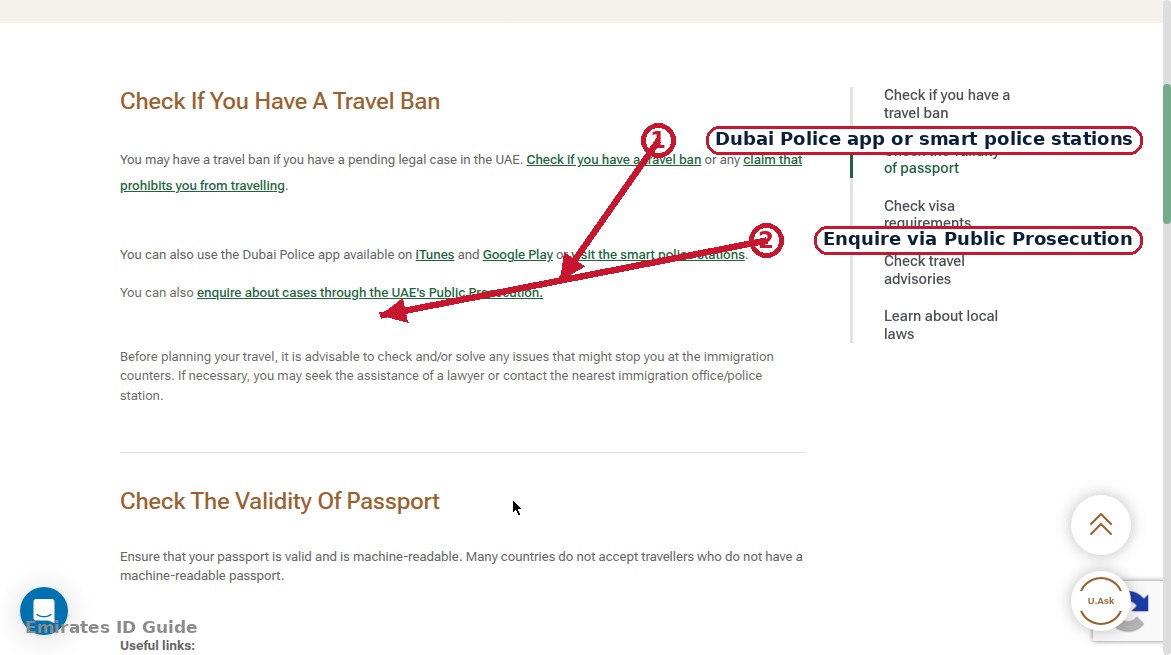
Method 1: Dubai Police Financial Case Inquiry (Dubai)
Dubai Police offers a public service that lets individuals inquire about the criminal status of financial cases registered against them in Dubai, the single most useful online check for travel-ban concerns in the emirate. It is free and uses your Emirates ID.
Step-by-step
- Open the Dubai Police official website or app and look for the service inquiring about the criminal status of financial cases (usually listed under public or criminal services).
- Enter your Emirates ID number as requested, along with any additional verification details.
- Submit the inquiry. The service indicates whether any financial cases are registered against you in Dubai's system.
- Interpret the result carefully. A clear result for Dubai financial cases is reassuring, but remember it covers Dubai police records, read Method 2 for federal and immigration dimensions.
This service specifically addresses financial cases in Dubai. If your matter involves another emirate or a non-financial case, the channels below apply.
Method 2: Immigration & ICP Channels
For immigration-related restrictions, or for a broader federal picture, the immigration authorities are the relevant channel:
- ICP portal and smart services: the Federal Authority for Identity, Citizenship, Customs & Port Security (icp.gov.ae) provides smart services where you can review aspects of your immigration file using your Emirates ID, file number, or passport number.
- GDRFA (Dubai) / federal immigration services: for Dubai residency matters, GDRFA's services can clarify the status of your immigration file; in other emirates, the corresponding immigration authority applies.
- Check before visa actions: if you are renewing residency, changing sponsorship, or have recently resolved a case, verifying your file status through these portals confirms everything is clear.
Online immigration portals show file and fine status well, but they do not always display court-ordered bans with the same clarity as a direct inquiry. When in doubt, especially before important travel, combine an online check with the in-person verification below.
Method 3: In-Person Verification
For the most definitive answer, nothing beats asking the authorities directly:
- Amer centres / GDRFA service centres (Dubai): staff can review your immigration file status with your Emirates ID.
- Police stations: the general departments of police in each emirate can advise on case-related restrictions.
- Courts / public prosecution: if you know or suspect a specific case, the relevant court or prosecution office can confirm its status and any associated orders.
- Airline / airport immigration desks: not a recommended "check" method, by the time you are at the airport, it is too late to fix anything.
Bring your original Emirates ID and passport. If a representative is inquiring on your behalf, they will normally need proper authorisation.
What to Do If a Ban Exists
Discovering a ban is stressful, but it is a solvable administrative and legal matter. Work through these steps:
- Identify the underlying case. Find out which authority issued the ban and the case reference, you cannot resolve what you cannot name.
- Address the root cause. For debts, this usually means settling the amount or negotiating a payment arrangement with the creditor; for other cases, complying with the court's requirements.
- Obtain clearance documentation. After settlement or judgment, ensure you receive official confirmation that the matter is closed.
- Confirm the ban is lifted. Ask the issuing authority to verify removal, and re-check through the inquiry channels above before travelling.
- Seek professional help for complex cases. If the matter involves significant sums, criminal proceedings, or multiple cases, engage a licensed UAE lawyer rather than navigating it alone.
Do not attempt to travel "to test" whether a ban is still active. Attempting to leave while a ban is in force can create additional legal complications.
Frequently Asked Questions
Can I check a UAE travel ban online for free?
Yes, Dubai Police's financial-case status inquiry is a free public online service, and immigration file checks through ICP/GDRFA smart services are also free. For complete certainty, especially with court matters, an in-person verification is recommended.
Will unpaid traffic fines cause a travel ban?
No. Ordinary traffic and administrative fines do not directly trigger travel bans. Bans are linked to court cases, debts, criminal matters, or serious immigration violations, not routine fines. That said, never let government debts escalate unattended.
How long does it take to lift a travel ban?
It varies with the case type and the authority involved. Once the underlying matter is fully resolved and documented, the issuing authority processes the lifting, confirm directly with them and re-verify your status before booking travel.
Can someone check my travel ban status for me?
Generally, inquiries require your own identity documents. A representative typically needs formal authorisation (such as a power of attorney) to act on your behalf with police, courts, or immigration.
Does a travel ban affect residency visa renewal?
It can. An unresolved case underlying a ban may also block renewals and other government transactions. Resolving the root matter addresses both issues together.
Is this guide legal advice?
No. This guide describes official public inquiry channels for general information only. For advice about your specific situation, consult a licensed legal professional in the UAE.
How far in advance should I check before travelling?
At least one to two weeks before your flight, longer if you have any reason to suspect an unresolved matter. Checking the night before leaves no time to act: identifying a case, settling it, obtaining clearance, and having the ban lifted is a multi-step process that cannot be rushed at the airport.
Can a travel ban be issued without my knowledge?
Yes. Court and enforcement orders do not always reach the person concerned promptly, particularly if contact details on file are outdated. This is precisely why a proactive check matters, many people only learn of a ban when they attempt to travel. Keep your Emirates ID, phone number, and address current across government records so official notifications can reach you.
Does leaving and re-entering the UAE clear a travel ban?
No. A travel ban remains in force until the issuing authority formally lifts it. Attempting to travel while a ban is active does not reset or cancel anything and can create additional legal complications. Resolve the underlying case first, obtain written clearance, and verify the ban is lifted before booking.
Conclusion
A travel ban check by Emirates ID is a simple precaution: use Dubai Police's financial-case inquiry for Dubai matters, ICP and immigration channels for the federal picture, and in-person verification when certainty matters most. If a ban exists, identify the case, resolve it, obtain clearance, and verify removal before you fly.
Next steps: clear everyday fines with our Dubai and Abu Dhabi fine check guides, or read about Emirates ID renewal to keep your identity documents, and your travel plans, in good standing. To check whether a case file sits behind a restriction, read our guide on case inquiry by Emirates ID.